Turbines are designed to operate within tightly controlled speed limits. When a turbine exceeds these limits, the resulting overspeed condition places extreme mechanical stress on blades, shafts, and bearings. In severe cases, it can lead to catastrophic equipment failure and significant safety risks.

This is why modern turbine installations use an overspeed detection system as part of their protection architecture. Combined with continuous condition monitoring, these systems identify dangerous operating conditions and initiate rapid shutdown procedures before damage occurs. Sensonics has provided high integrity overspeed protection systems for over 20 years, with proven field reliability across conventional and nuclear power generation.
Below are four common causes of turbine overspeed, along with the protective mechanisms used to prevent failures.
Cause #1: Sudden Load Rejection
A sudden loss of load is one of the most frequent triggers of turbine overspeed. This situation occurs when a turbine continues producing power while the connected load is unexpectedly removed. In power generation systems, if the electrical grid disconnects or a breaker trips, the turbine's driving energy remains momentarily unchanged. Without resistance from the generator load, the rotor can accelerate rapidly beyond safe limits.
How Protection Systems Respond?
An overspeed detection system continuously measures rotor speed using strategically placed sensors. If the speed exceeds a predefined threshold, the protection system immediately activates your emergency shutdown procedures.
Typical responses include:
-
Closing control valves
-
Cutting fuel or steam supply
-
Activating trip mechanisms
Because load rejection events can escalate within seconds, response time is critical. The Sensonics overspeed protection system achieves a response time of less than 20ms — ensuring the system reacts fast enough to protect the machine before speed reaches damaging levels.
Continuous condition monitoring also supports this scenario by allowing operators to analyse speed behaviour trends and detect instability before a load rejection event occurs.
Cause #2: Failure of the Turbine Speed Governor
The turbine speed governor regulates turbine speed by adjusting the amount of energy entering the system. When functioning correctly, it maintains stable operation even as load conditions change. However, if the governor fails (e.g. due to mechanical wear, control system faults, or sensor issues)
the turbine may continue receiving energy without proper regulation, causing the rotor to accelerate uncontrollably.
How Protection Systems Respond?
Modern turbines incorporate independent safety layers that operate separately from the main control system. Even if the governor fails, the turbine is protected by a dedicated overspeed protection mechanism that does not rely on the governor’s own instrumentation.
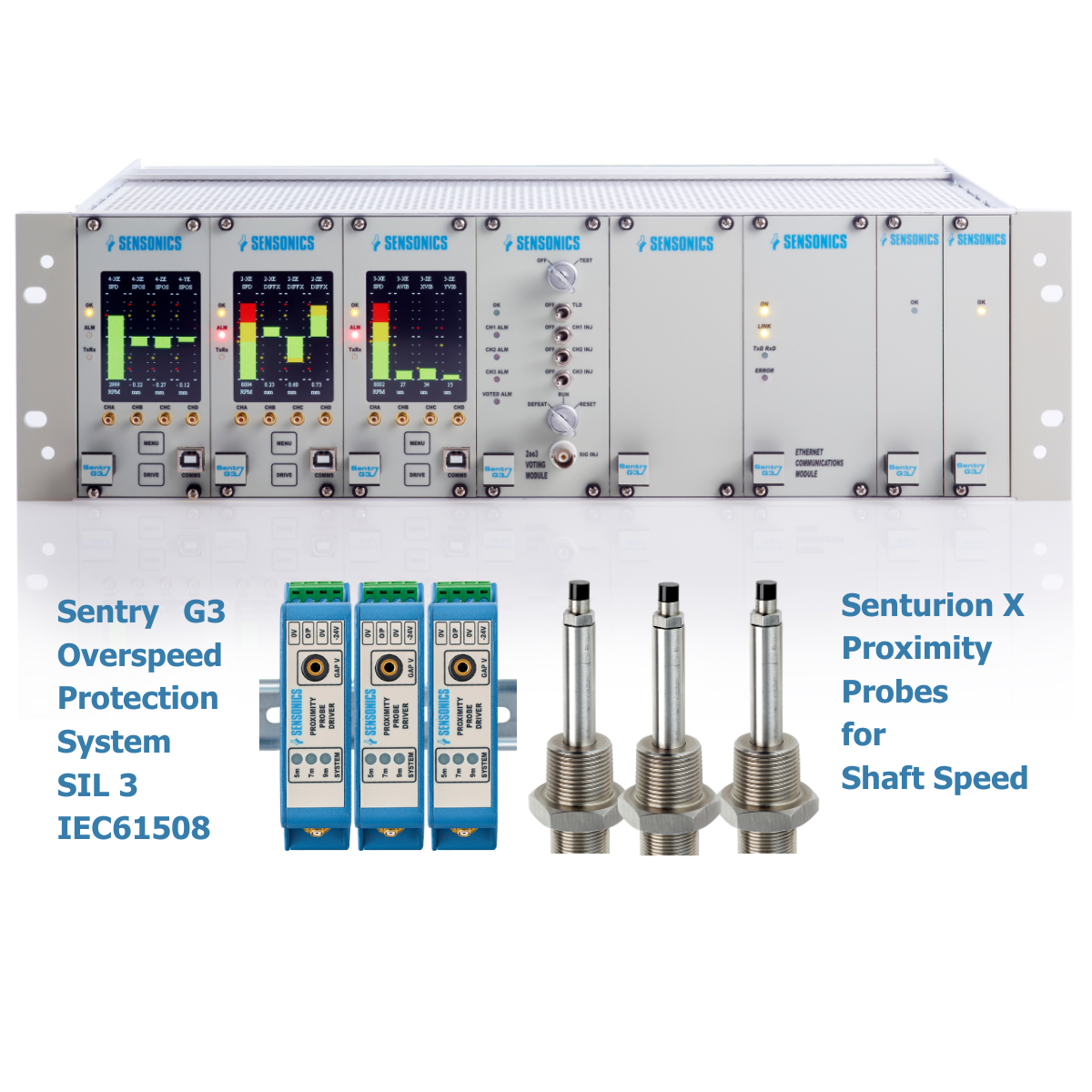
The Sensonics overspeed protection system is approved to IEC 61508 SIL-3 — the highest integrity level applicable to most turbine protection applications — providing assurance that the protection system will function correctly even when primary control has been lost. A dual redundant power supply option further ensures the system remains operational under fault conditions.
Cause #3: Control Valve Malfunction
Control valves regulate the flow of steam, gas, or other working fluids entering the turbine and must respond precisely to changing operating conditions. If a valve becomes stuck in an open position, opens unexpectedly, or fails to respond to control signals, excessive energy may enter the turbine and can drive the rotor to dangerous speed.
Valve failures may result from:
-
actuator faults
-
hydraulic system problems
-
mechanical sticking
-
control signal errors
How Protection Systems Respond?
Protection systems are designed to operate independently of the valve control mechanisms. If the turbine begins accelerating abnormally, the overspeed detection system immediately identifies the rising speed and initiates protective responses — including closing isolation valves, cutting energy input, or triggering a full turbine trip — regardless of the state of the valve control system.
Cause #4: Faulty Speed Measurement or Sensor Errors
Accurate speed measurement is the foundation of any overspeed protection system. If sensors providing speed data become inaccurate, the control system may receive incorrect information and the turbine may operate outside safe limits without the control system recognising the danger.
Sensor issues can occur due to:
-
calibration drift
-
electrical faults
-
wiring damage
-
environmental exposure
-
ageing instrumentation
How Protection Systems Respond?
To address this risk, the Sensonics overspeed protection system uses a voted 2-out-of-3 sensor arrangement as standard. This means that three independent speed measurements are taken simultaneously, and a trip is only initiated when at least two of the three sensors agree that an overspeed condition exists. This voting logic eliminates single-point failure — preventing both spurious trips caused by a single faulty sensor and undetected failures where one sensor stops responding.
This architecture is consistent with the redundancy requirements of API 670, the industry standard for machinery protection systems, and supports the system's IEC 61508 SIL-3 approval. Online test, trip, and signal injection facilities allow the protection system to be tested and verified while the turbine remains in service — without compromising protection integrity.
The Sensonics DN26 G3 Tacho Monitor provides a single-channel option for applications where a full voted system is not required, offering high-visibility display, flexible alarm functionality, and easy OEM integration.
Find Out More
Every turbine application has different protection requirements. Sensonics has over 20 years of experience designing and supplying overspeed protection systems for conventional and nuclear power generation, with SIL-3 approved solutions and proven field reliability.
Contact a Sensonics specialist to discuss your overspeed protection requirements and find out how the Sentry G3 platform can be configured for your application.
Turbine overspeed is a high-consequence event that can escalate in seconds. Our new article examines four common causes and explains how a SIL-3 approved overspeed detection system — with 2-of-3 voting logic and sub-20ms response time — provides the protection margins your installation requires. Read the full article on the Sensonics blog.