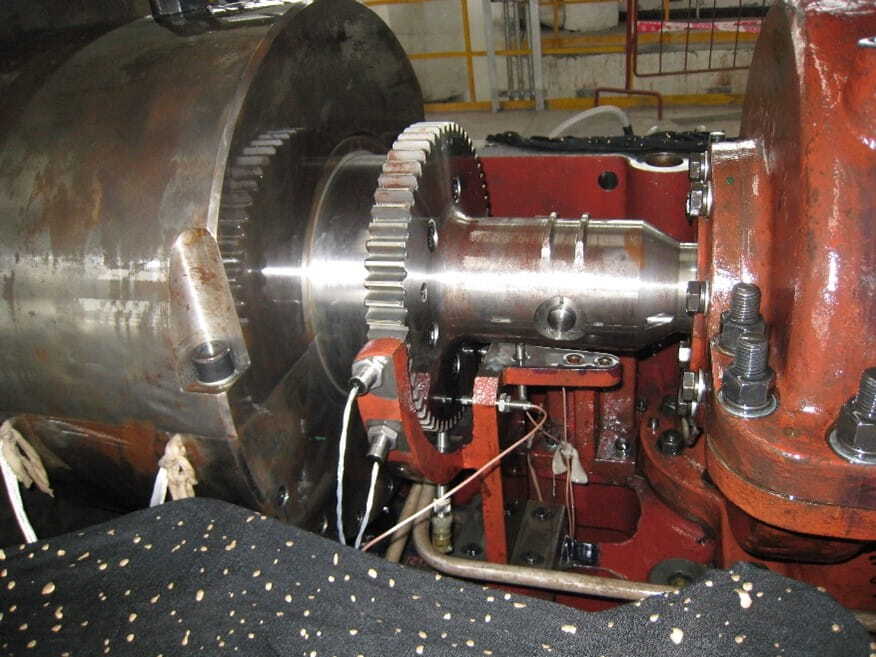
Unlike sensor selection or analytics configuration, installation errors are often expensive – or impossible – to correct without shutting down your equipment. Unfortunately, these errors are often difficult to detect once systems are commissioned, and may only become apparent after weeks or months of supposedly normal operation.

This is why installation quality has a disproportionate impact on long-term monitoring performance. As a result, sensor installations should be treated as a critical engineering activity rather than a procedural task completed during commissioning. In this article, we explain why, and how you can avoid expensive mistakes.
How installation defects distort vibration signals before analysis begins
A common misconception is that poor sensor installation simply adds ‘noise’ to the vibration signals. This is damaging enough, but installation defects often introduce systematic bias by altering how vibrations are transmitted to the sensor. Insufficient mounting stiffness, uneven contact surfaces, or poorly prepared mounting points can all subtly change the sensor’s effective frequency response.
This bias is particularly problematic because it does not always manifest as obviously incorrect data. Trends may appear stable and repeatable while still misrepresenting actual machine behaviour. And once such bias is embedded in baseline data, it becomes difficult to distinguish genuine mechanical change from installation-induced distortion.
Why mechanical coupling determines what the sensor can actually detect
The mounting interface between sensor and machine structure is a mechanical system in its own right. If this interface lacks rigidity, higher-frequency vibration components may be attenuated or phase-shifted before they reach the sensing element. For rolling element bearing applications, this can suppress the very frequency content required to detect early-stage defects.
While accelerometers are widely used and well suited to industrial environments, their performance characteristics depend fundamentally on effective mechanical coupling. Stud-mounted installations typically provide the most predictable response, whereas adhesive or magnetic mounting methods can cause variability between machines or over time.
The consequences of placing sensors outside critical vibration transmission paths
Sensor placement errors are among the most common and least recognised causes of ineffective condition monitoring. Installing sensors on structurally compliant surfaces, covers, or auxiliary components may still produce vibration data, but that data often reflects local structural behaviour rather than the condition of the machine element of interest.
Unfortunately, once a sensor is installed in a suboptimal location, the resulting data may be internally consistent yet poorly correlated with actual fault development. This creates analysis effort without actionable insight, increasing your diagnostic workload while reducing confidence in the conclusions. Correct placement requires an understanding of vibration transmission paths and – sometimes – prioritising structural relevance over physical accessibility.
Signal degradation caused by inadequate cabling and electrical practices
In permanent condition monitoring systems, cabling and termination practices frequently determine long-term system stability. Inadequately supported cables are subject to fatigue, while poor shielding or grounding can trigger intermittent electrical interference that mimics mechanical anomalies.
These issues rarely appear during commissioning tests, emerging instead after months or even years of service. Because such faults are intermittent and location-dependent, they are often misinterpreted as process-related or mechanical issues. Robust cable routing, strain relief, and environmental protection are therefore integral aspects of sensor installation.
When field installation prevents calibrated sensors from performing as intended
Although vibration sensor calibration confirms sensor accuracy under controlled conditions, installation quality determines how closely calibrated performance is realised in service. Mechanical compliance and environmental exposure influence how calibration translates into field measurements. If installation quality varies between similar machines, calibrated sensors may still produce non-comparable data, limiting the usefulness of cross-asset analysis. In this context, installation consistency is often more influential than calibration precision in determining how data can be used operationally.
The long-term impact of installation choices on monitoring systems
The most significant consequence of poor installation is not degraded data quality alone, but the cost and disruption associated with correction. Retrofitting improved mounting, relocating sensors, or replacing damaged cabling typically requires machine access that is unavailable outside planned outages. As a result, installation decisions made during commissioning frequently persist for the operational life of the system. Investing engineering effort at the installation stage therefore delivers returns by avoiding years of compromised monitoring performance or costly rework.
Next steps
At Sensonics, we work with asset owners to ensure their monitoring systems deliver reliable, usable data throughout the full operational life of the plant. If you’d like to find out more about improving vibration monitoring performance, or for support choosing the right sensors for your application, please contact us today.